




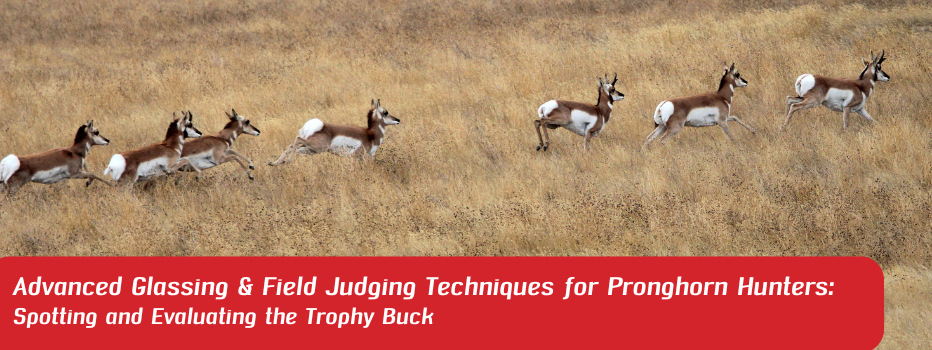
Pronghorn hunting offers a unique and thrilling challenge, especially when it comes to identifying and pursuing mature bucks. Known for their incredible speed and keen eyesight, pronghorns can be elusive targets, requiring a hunter to employ a combination of patience, precision, and expertise. For the experienced hunter, glassing and field judging are critical skills that can make or break a hunt. In this blog, we’ll explore advanced techniques for glassing and field judging pronghorns, with a particular focus on identifying and evaluating mature bucks.
The Importance of Effective Glassing
Glassing is a fundamental skill in pronghorn hunting, especially given the open terrain and the species’ tendency to stay in wide, flat areas where they can easily spot predators. Here’s how to maximize your glassing efforts:
- Choosing the Right Optics: Quality optics are non-negotiable for pronghorn hunting. A good pair of binoculars (10×42 or 12×50 are popular choices) and a spotting scope with at least 20-60x magnification are essential for locating and evaluating bucks from a distance. According to optics expert Tom McIntyre, “Investing in high-quality optics can significantly improve your ability to spot and judge pronghorns at long distances, reducing the need for excessive repositioning and increasing your chances of finding a trophy buck” (McIntyre, 2018).
- Glassing Techniques: Begin your glassing by methodically scanning the landscape from a high vantage point. Use a grid pattern to cover the terrain, ensuring you don’t miss any details. Start by glassing close and gradually extend your focus to more distant areas. This approach helps to catch pronghorns that might be bedded down or blending into the terrain. As pronghorn expert Wayne van Zwoll notes, “Pronghorns have an uncanny ability to blend into their environment, so taking your time and scanning methodically is crucial to spotting them before they spot you” (van Zwoll, 2020).
- Time of Day: Early morning and late afternoon are prime times for glassing, as pronghorns are more likely to be active and feeding during these cooler parts of the day. The low-angle light also helps to create shadows that can reveal the presence of pronghorns against the landscape.
- Spotting Groups vs. Solitary Bucks: Mature pronghorn bucks may either be solitary or found in small bachelor groups, particularly early in the season. Watch for the distinct behavior of mature bucks—they often stand apart from does and younger bucks and may be more cautious in their movements. Spotting a lone pronghorn often signals a buck worth closer inspection.
Field Judging Pronghorn Bucks
Once you’ve spotted pronghorns through your optics, the next step is field judging to determine if the buck is mature and worthy of pursuit. Field judging pronghorns is an art that involves assessing various physical characteristics:
- Horn Length and Shape: One of the primary indicators of a trophy pronghorn is horn length. A mature buck’s horns typically measure between 14 to 16 inches, though exceptional bucks can exceed 17 inches. When judging horn length, consider the height of the horns relative to the pronghorn’s ears, which are generally about 6 inches long. A good rule of thumb is that if the horns are twice the length of the ears, the buck is likely a trophy candidate. Wildlife biologist Jim Heffelfinger advises, “Horn shape is just as important as length. Look for heavy bases, deep curls, and a prominent hook at the tips, which are indicators of age and maturity” (Heffelfinger, 2019).
- Mass and Circumference: The mass, or thickness, of the horns is a crucial factor in determining a trophy pronghorn. The circumference of the horns at the base should be substantial—ideally around 6 inches or more. A buck with good mass will have horns that appear heavy throughout their length, not just at the base. “Mass is the most overlooked aspect when field judging pronghorns. A buck with thick, well-massed horns can outscore a longer-horned buck with thin mass,” explains hunting guide and pronghorn specialist Clay Newcomb (Newcomb, 2021).
- Prong Position and Length: The prongs, or cutters, on a pronghorn’s horns are another key element to consider. Mature bucks typically have prongs that extend at least 2 to 4 inches forward and are positioned well above the ear line. The higher the prongs sit on the horns, the longer the lower section of the horns will be, which contributes to a higher score. “A mature buck’s prongs will be both prominent and positioned high on the horns, creating an impressive and balanced look,” notes Heffelfinger.
- Overall Symmetry and Appearance: Trophy pronghorns exhibit symmetry and balance in their horns. While some hunters are drawn to unique or non-typical horn configurations, the best-scoring bucks usually have horns that mirror each other in length, mass, and prong position. When field judging, consider how the horns look in profile and from head-on. Bucks with well-balanced, symmetrical horns are often older and have had the time to develop fully.
- Body Characteristics: Mature bucks also display distinctive body characteristics. Look for a deep chest, muscular build, and a thick neck, particularly during the rut. The facial markings of a mature buck are often more defined, with darker, more prominent cheek patches. Pronghorn expert Tom Miranda suggests, “When field judging, don’t just focus on the horns—consider the overall condition and stature of the buck, which can give you clues about its age and health” (Miranda, 2018).
Stalking and Closing the Distance
After identifying a potential trophy buck, the next challenge is closing the distance without alerting the pronghorn to your presence. Pronghorns are known for their exceptional eyesight, so stealth and strategy are key:
- Wind and Scent Control: Always approach with the wind in your favor, as pronghorns rely heavily on their sense of smell to detect danger. Use scent-eliminating sprays and consider the wind direction when planning your stalk. “Scent control is critical when stalking pronghorns. These animals have an incredible sense of smell and can pick up your scent from a long distance,” advises Newcomb.
- Using Terrain to Your Advantage: The open terrain that pronghorns inhabit can make stalking difficult, but even slight changes in elevation or small dips in the landscape can provide the cover you need. Use ridges, draws, and even shallow depressions to stay out of sight as you close the distance. Move slowly and deliberately, keeping a low profile. As Miranda suggests, “Pronghorns are constantly scanning their surroundings, so use every bit of natural cover available to stay hidden” (Miranda, 2018).
- Timing the Stalk: The best time to stalk a pronghorn is when it is bedded down, as this reduces the likelihood of detection. Watch for signs that the buck is getting ready to bed, such as repeated head lowering or circling to find a comfortable spot. Once the pronghorn beds down, take your time to approach, moving only when the animal’s head is turned away from you.
Conclusion
Pronghorn hunting is a pursuit that rewards the patient and meticulous hunter. By mastering the techniques of glassing and field judging, you can increase your chances of identifying and harvesting a mature, trophy-worthy buck. Remember, the key to success lies in careful observation, accurate evaluation, and strategic stalking.
At Negrini, we understand the dedication required to pursue trophy pronghorns. Our lightweight, durable gun cases are designed to protect your firearms during the long days in the field, ensuring that your equipment is as ready as you are when the moment of truth arrives. Equip yourself with the best, and take on the challenge of pronghorn hunting with confidence.
References:
- McIntyre, T. (2018). The Essential Guide to Hunting Optics. Outdoor Life.
- van Zwoll, W. (2020). Mastering the Art of Pronghorn Hunting. Field & Stream.
- Heffelfinger, J. (2019). Understanding Pronghorn Horn Growth. Western Hunter.
- Newcomb, C. (2021). Field Judging Pronghorns: Tips from a Pro. Bear Hunting Magazine.
- Miranda, T. (2018). Advanced Pronghorn Hunting Strategies. Bowhunter Magazine.