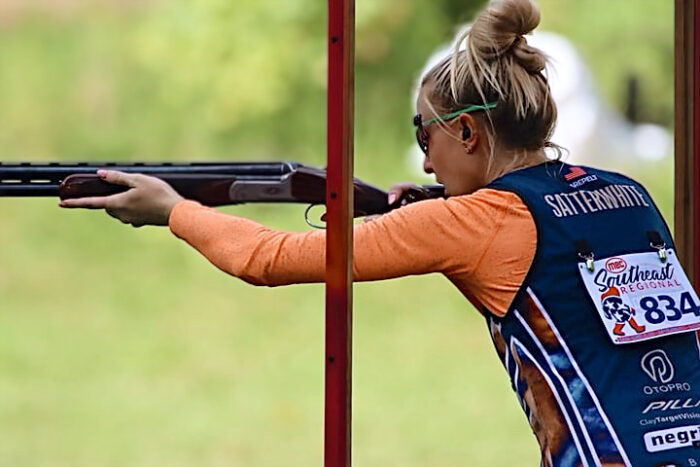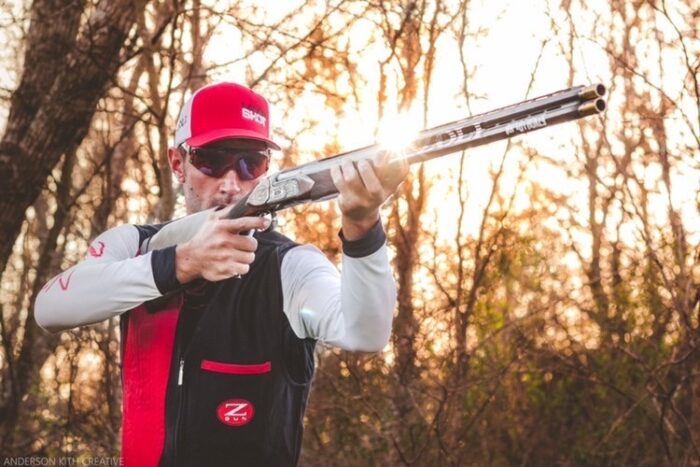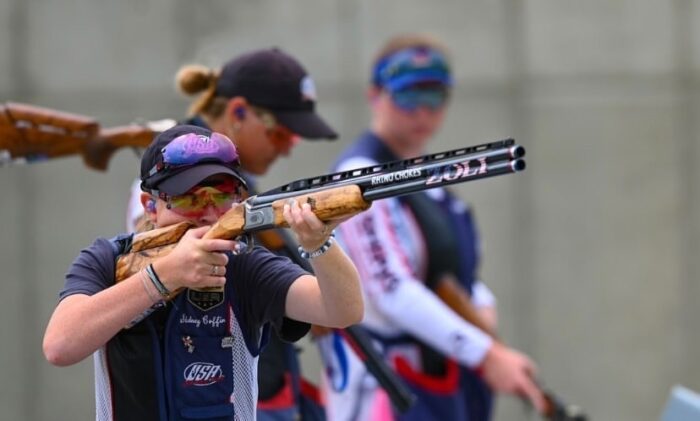






For competitive shotgun shooters, stance is more than just foot placement – it’s a dynamic, biomechanical system that affects balance, movement efficiency, and recoil absorption. A stance that works for a high, rising teal won’t be as effective for a low, dropping incomer or a hard crosser at 40 yards.
According to Gil and Vicki Ash of OSP Shooting School, stance plays a critical role in how the brain processes visual input and translates it into efficient movement. If the stance is rigid or misaligned, the shooter’s visual reaction time slows, causing delayed muzzle movement, poor gun control, and inconsistent shot execution (Ash and Ash 128).
The best shooters adapt their stance in real-time based on how the brain perceives target movement and how their body can efficiently track that motion.
This article will take an expert-level look at the biomechanics of stance, diving into:
✔ The relationship between stance, vision, and shot execution.
✔ How minor stance changes affect balance, recoil management, and gun speed.
✔ Proven stance adjustments for rising, dropping, and crossing targets.
The Science Behind Stance: How the Brain & Body Work Together
1. Stance & Visual Processing: How Foot Position Affects Target Acquisition
In OSP Shooting School’s research, Gil and Vicki Ash emphasize that how a shooter’s body is positioned directly affects how the brain interprets target movement.
- A stance that is too squared off or rigid can force the shooter’s eyes into a static position, making it harder to track fast-moving targets efficiently.
- A stance that is slightly open and balanced allows for better eye mobility and depth perception, improving target pickup speed by up to 20% in high-level competitors (Ash and Ash 133).
Key Insight: Stance influences how quickly and accurately the brain processes the target’s movement, which in turn affects shot timing and consistency.
2. Stance & Balance: The Neuromuscular Response to Recoil
- The brain anticipates recoil before the shot is fired. When a shooter is unbalanced, the brain compensates by sending signals to stabilize the body mid-shot, which creates inconsistent gun movement and erratic follow-through.
- A shooter with an optimized stance absorbs recoil through the legs and core, preventing the upper body from making unnecessary corrections.
Key Insight: Shooters with a stable, adjusted stance return to their shooting plane faster, allowing for better second-shot accuracy in pairs.
Case Study from OSP:
In a study with top-level sporting clays shooters, those who adjusted their stance based on target direction experienced 15-25% faster recovery time between shots compared to shooters using a static stance.
Breaking Down Stance Adjustments by Target Type
1. Stance for Rising Targets (Teal, Outgoing Birds, Rising Crossers)
The Challenge:
Rising targets demand upward barrel movement, which means:
- Shooters must engage their front foot to drive the gun vertically without excessive backward lean.
- A stance that is too rear-weighted results in delayed muzzle movement and poor gun speed control.
Optimal Stance for Rising Targets:
- Weight Distribution: 60% on the front foot to counteract upward recoil.
- Foot Positioning:
- Front foot pointed toward the break point (~10-15 degrees forward).
- Rear foot positioned slightly open (~30-40 degrees) for unrestricted torso movement.
- Upper Body Balance:
- Slight forward lean to prevent being pushed backward by recoil.
Key Execution Tip:
The eyes must lead the barrel. A proper stance allows the shooter to visually lock onto the target first, ensuring a natural swing through the breakpoint rather than chasing the target with the gun.
Pro Insight from OSP:
Gil and Vicki Ash emphasize that shooters should “push” the gun upward through the target, using their stance to initiate gun movement, not just their arms (Ash 137).
2. Stance for Dropping Targets (Incoming Teal, Chondelles, Quartering Incomers)
The Challenge:
Dropping targets create an illusion of slowing down, causing:
- Overtracking, leading to over-correction.
- Disruptions in gun speed due to excessive barrel movement.
- Inconsistent shot timing when transitioning from rising to dropping targets.
Optimal Stance for Dropping Targets:
- Weight Distribution: Balanced (50/50) to allow smooth downward movement.
- Foot Positioning:
- Feet slightly wider than normal for increased stability.
- Front foot neutral or slightly back to control upper-body movement.
- Upper Body Control:
- Keep the torso engaged but upright to prevent collapsing into the shot.
Key Execution Tip:
Let the target fall into your shot window. Avoid unnecessary last-second adjustments by maintaining a stance that allows the barrel to track the target smoothly downward.
Pro Insight from OSP:
Vicki Ash emphasizes that shooters should train their brain to “see” dropping targets as faster than they appear, which prevents hesitation caused by visual misinterpretation (Ash 142).
3. Stance for Crossing Targets (Left-to-Right & Right-to-Left)
The Challenge:
Crossing targets require:
- Rotational flexibility to maintain barrel momentum without arm overcorrection.
- A stance that allows natural gun movement rather than forced adjustment.
Optimal Stance for Crossing Targets:
- Weight Distribution: 55% on the front foot, 45% on the rear foot to allow for natural rotation.
- Foot Positioning:
- Front foot angled slightly toward the break point.
- Rear foot positioned to allow unrestricted torso movement.
- Upper Body Control:
- Keep weight engaged on the front foot, allowing smooth hip rotation.
Key Execution Tip:
Use your lower body – not your arms – to track crossers. A proper stance enables a fluid swing, keeping the gun connected to the target.
Pro Insight from OSP:
Gil Ash emphasizes that stance in crossers should create a “spring-loaded effect” where the lower body absorbs recoil, allowing the upper body to move freely through the shot (Ash 145).
Final Thoughts: Why Stance Adjustments Are a Competitive Advantage
✔ Your stance isn’t just a foundation – it’s a performance enhancer.
✔ Target presentation dictates stance, not the other way around.
✔ Adjusting stance for rising, dropping, and crossing targets creates a smoother, more controlled shot.
The best shooters don’t try to adapt their shots to a single stance, they adjust their stance to match the demands of the target.
References
- Ash, Gil, and Vicki Ash. Sporting Clays Consistency: You Gotta Be Out of Your Mind!. OSP Shooting School, 2019.
- Digweed, George. Competitive FITASC Shooting Mechanics. Clay Shooting Press, 2021.
- Faulds, Richard. Break Clays Like a Champion: Advanced Sporting Clays Techniques. Stackpole Books, 2018.
- Wilber, Randall L. Sports Endurance & Muscle Fatigue Science. Human Kinetics, 2007.
- Yardley, Michael. Positive Shooting: A Guide to Competitive Clay Shooting. Quiller Publishing, 2017.